Key takeaways
- Ticket Omaha built three themed event pages – Family Activities, Fan Favorites and Date Night – and placed them on their homepage alongside their usual ‘What’s On’ page.
- In the most recent month, two of the three theme pages sent a higher share of visitors on to an event than the main ‘What’s On’ page: around 30%, compared with 24%.
- In the first eight weeks, visitors using the site search were four to seven times more likely to click through to a theme page than visitors on the homepage, suggesting these pages work best when visitors have clear intentions.
- The team’s own read on the results: the pages work well for the visitors who find them, but not enough people are finding them yet. The next phase of the experiment is about testing prominence and layout.
Ticket Omaha, the official ticketing retailer for venues including the Orpheum Theater and Holland Center, runs on a familiar model for event discovery: a central ‘What’s On’ list. Between 14 September and 13 October, 24% of visits to that page clicked through to an individual event.
That suits people who arrive ready to browse. The harder problem is the other three in four, who don’t click through to an event page.
This is the exact gap that Martin Gammeltoft and Dr Patricia Stainer explored in their piece on event discovery: standard ‘What’s On’ pages serve confident, returning visitors well, but leave more hesitant browsers to do all the work of orienting themselves. The proposed fix isn’t to replace the list, but to add situational, human entry points alongside it: pages built around a mood or moment, not a genre or filter, for the visitors who aren’t sure where to start.
The experiment
Working with the CultureSuite team, Ticket Omaha’s Digital Marketing Manager Emily Singer set up three theme pages under a ‘More to explore’ section on the homepage:
- Family Activities
- Fan Favorites
- Date Night
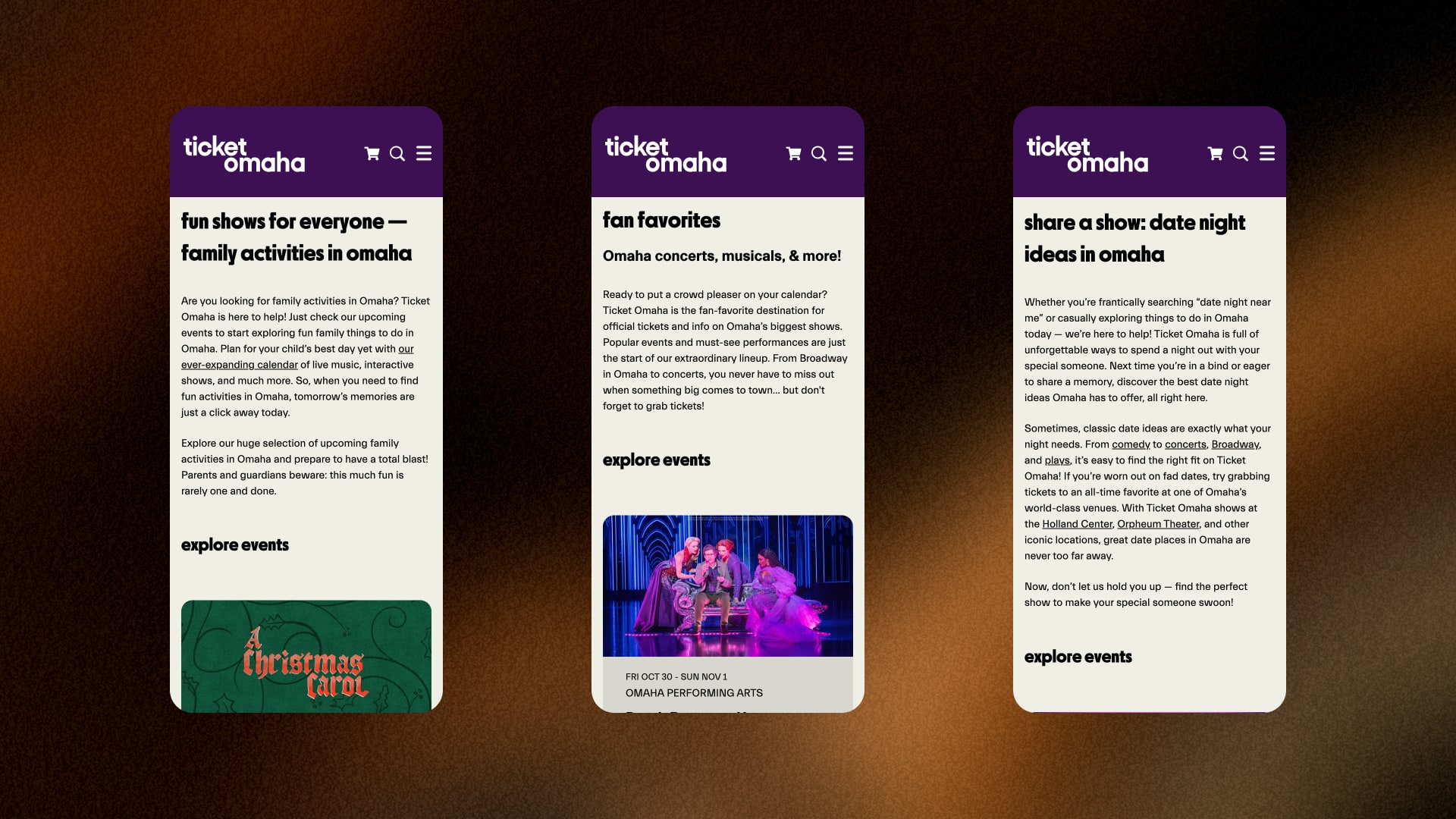
Each one sat as an additional route into the Ticket Omaha programme, rather than a replacement for the existing ‘What’s On’ list. The pages launched on 23 April 2026, and the team has looked at two questions: what visitors did once they reached the pages (the most recent month, 14 September – 13 October), and how they found them in the first place (the first eight weeks, 23 April – 16 June).
What the data showed
What visitors did next: the most recent month.
Of the visitors who landed on each page between 14 September and 13 October, this is the share who went on to an individual event:
Family Activities and Fan Favorites both turned around 30% of their visitors into event page clicks, roughly a quarter more than the main ‘What’s On’ page managed. Date Night came in lower, at 15%. Not every theme will land equally, and finding out which ones do is exactly what testing them is for.
How visitors found the pages: the first eight weeks.
Early on, the team looked at how visitors were finding the theme pages in the first place, and the picture was clear. Fewer than 1% of homepage views led to a theme page, but click-through from the site’s own search results was far higher:
That’s four to seven times the homepage rate, from visitors who were already actively looking. It’s a strong early signal that theme pages work best when they meet a clear need, rather than relying on casual browsers to notice them on the homepage.
Visibility was the common thread in both phases.
In the most recent month, fewer than 1% of homepage views led to a theme page, the same pattern as the first eight weeks. It fits what Emily suspected: the theme pages section needs more visibility, something the team is looking to address next.
The team’s honest take
Reflecting on the results, Emily Singer pointed to visibility as the clearest opportunity for the next stage. The pages themselves were already resonating with the visitors who found them.
“Two of our three theme pages sent more visitors to an event than our main events page,” Emily explained. “Which is really encouraging for pages that are still early in their launch with less traffic behind them. The challenge now is getting more people to see them, so I’d like to try a new homepage layout and see what that does for visibility and sales.”
Two of the three theme pages performed well once visitors reached them, but overall traffic to them remains low, even though the section sits fairly near the top of the homepage. Visitors may simply need time to get used to a new way of browsing. The next phase of the experiment is about testing prominence and layout, not the underlying idea.
What’s next
Ticket Omaha and CultureSuite plan further iterations of the theme page approach, starting with homepage layout changes designed to give the theme pages more visibility. Rather than treating this as a one-off redesign, the plan is to keep it as a series of small, measurable changes – tracking clicks, paths, drop-offs and purchases at each step, and adjusting from there.
It’s an early look, but it points in a promising direction: two of the three theme pages sent a higher share of visitors on to an event than the main list. The next question is simply how to help more of them find one.
Want to help more visitors find their way to your events?
Whether you’re thinking about theme pages or just want to understand where visitors drop off on your website, we can help you work out what to try first.
- Curious how this could work for your venue?
Theme pages are built into the CultureSuite CMS, so you can set them up yourself and see what your visitors respond to. If you’d like to see how, we’d be glad to show you. Talk to us about event discovery. - Want to keep learning first?
Dive into more thinking on digital strategy through our articles, events and webinars, Spotify, YouTube channel or our newsletter.