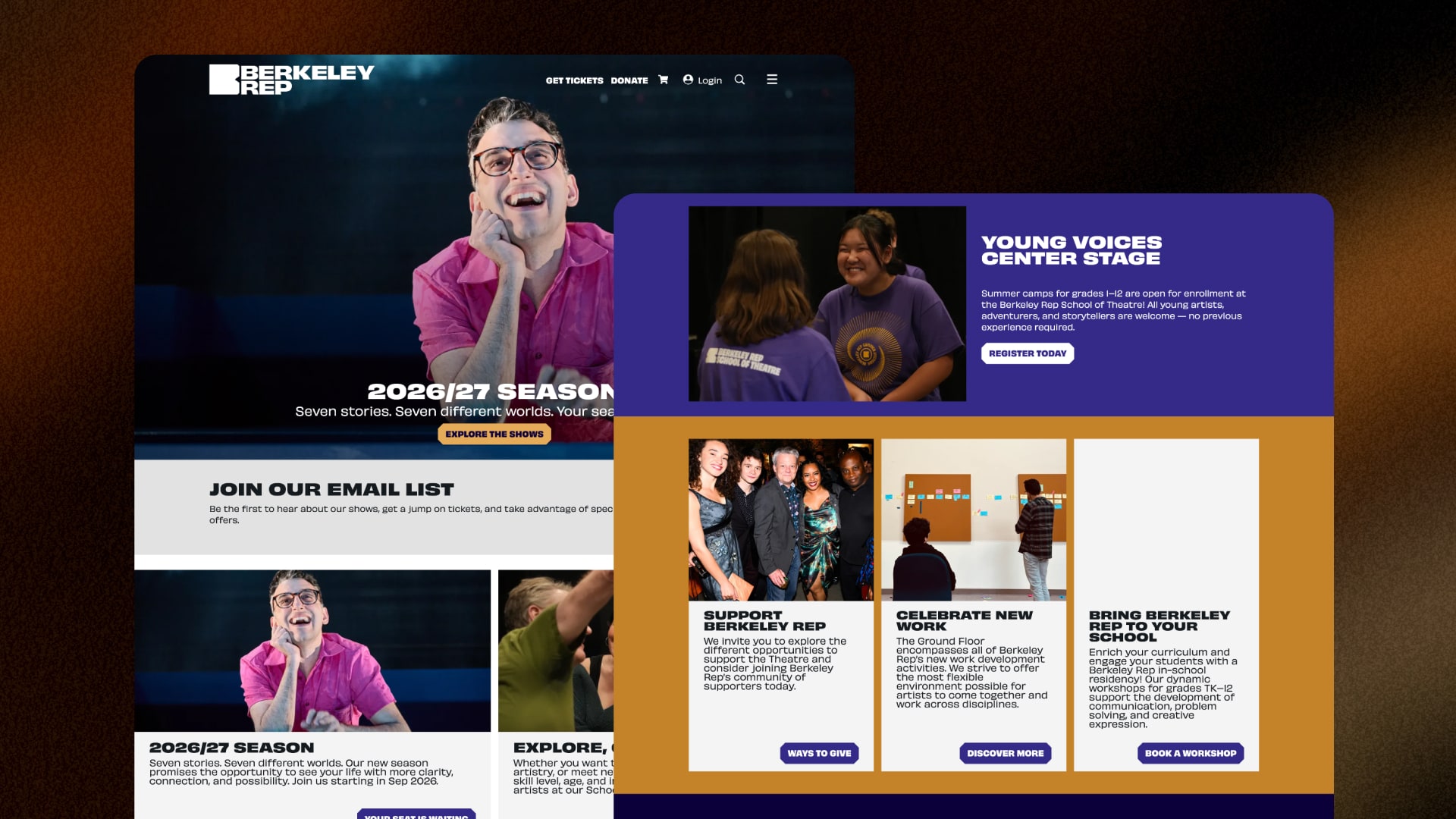
Berkeley Repertory Theatre has earned eight Tony Awards, eleven Drama Desk Awards, a Grammy and a Pulitzer Prize. Its reputation is extraordinary. But for a spell, the website was steadily undermining it. Not through bad design, but through friction that stopped patrons completing the journeys they came to make.
Shows were hard to find. Dates were hard to browse. Buying a ticket took more clicks than it should have.
The result was a small marketing operation, stretched across multiple stakeholder groups and without a dedicated web designer, spending far too much time managing manual workarounds instead of focusing on what actually matters: connecting audiences with exceptional theatre.
CultureSuite was brought in to change that.
About Berkeley Repertory Theatre
Founded in 1968, Berkeley Repertory Theatre is a non-profit theatre based in Berkeley, California. It produces a subscription season of new works and classics across two venues: the larger Roda Theatre and the more intimate Peet's Theatre, alongside The Ground Floor (a new-play development programme) and the School of Theatre, which offers classes for adults and young people.
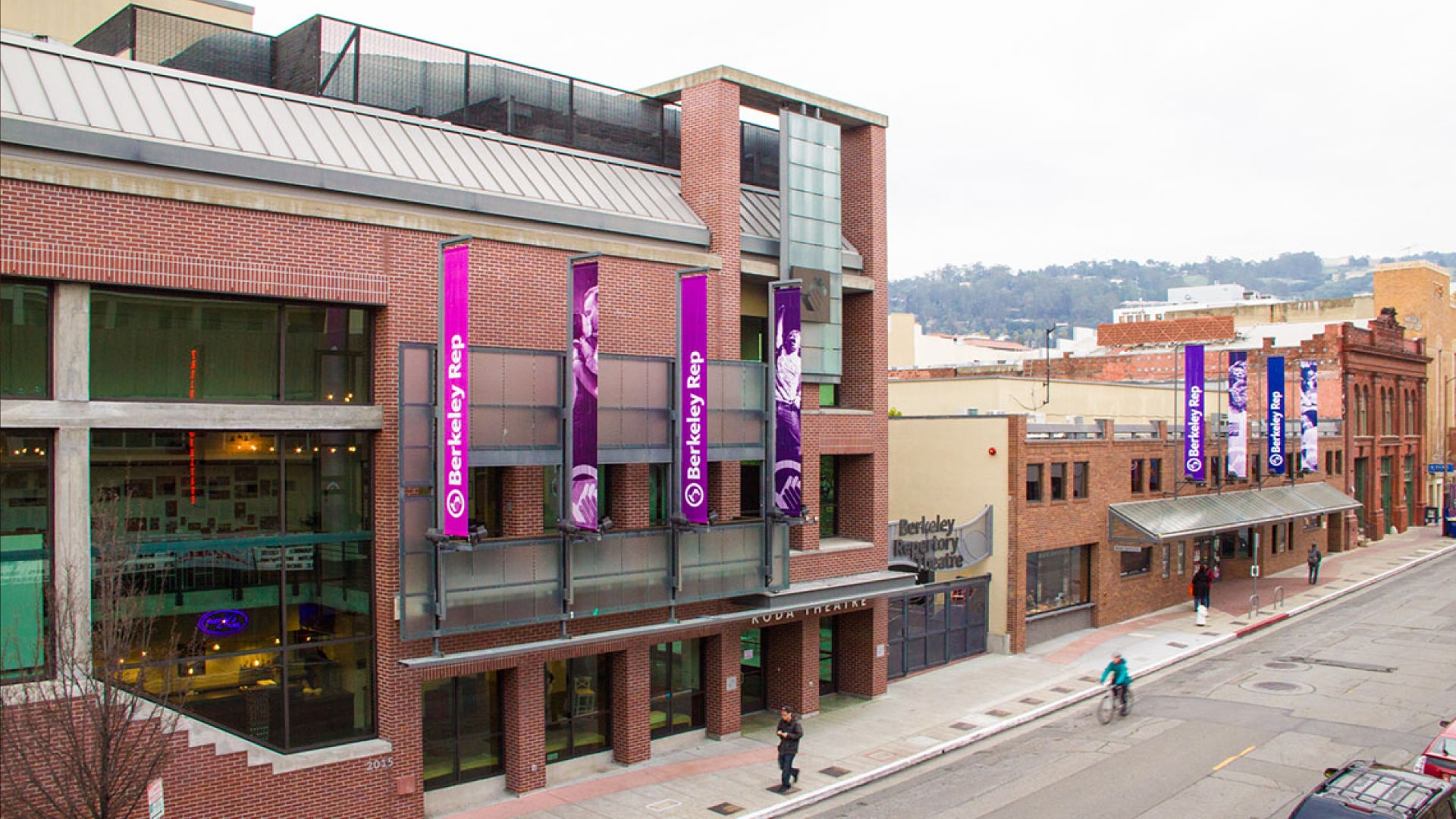
The organisation serves a wide range of audiences – individual ticket buyers, season subscribers, class participants, donors, artists, school groups, sponsors and funders. And until recently, all of them were being asked to navigate the same site, with no clear path for any of them.
The challenge
The problems at Berkeley Rep weren't unusual. They're the kind of challenges that accumulate gradually on any busy venue website, and they're exactly the kind CultureSuite is built to solve.
Event discoverability caused friction
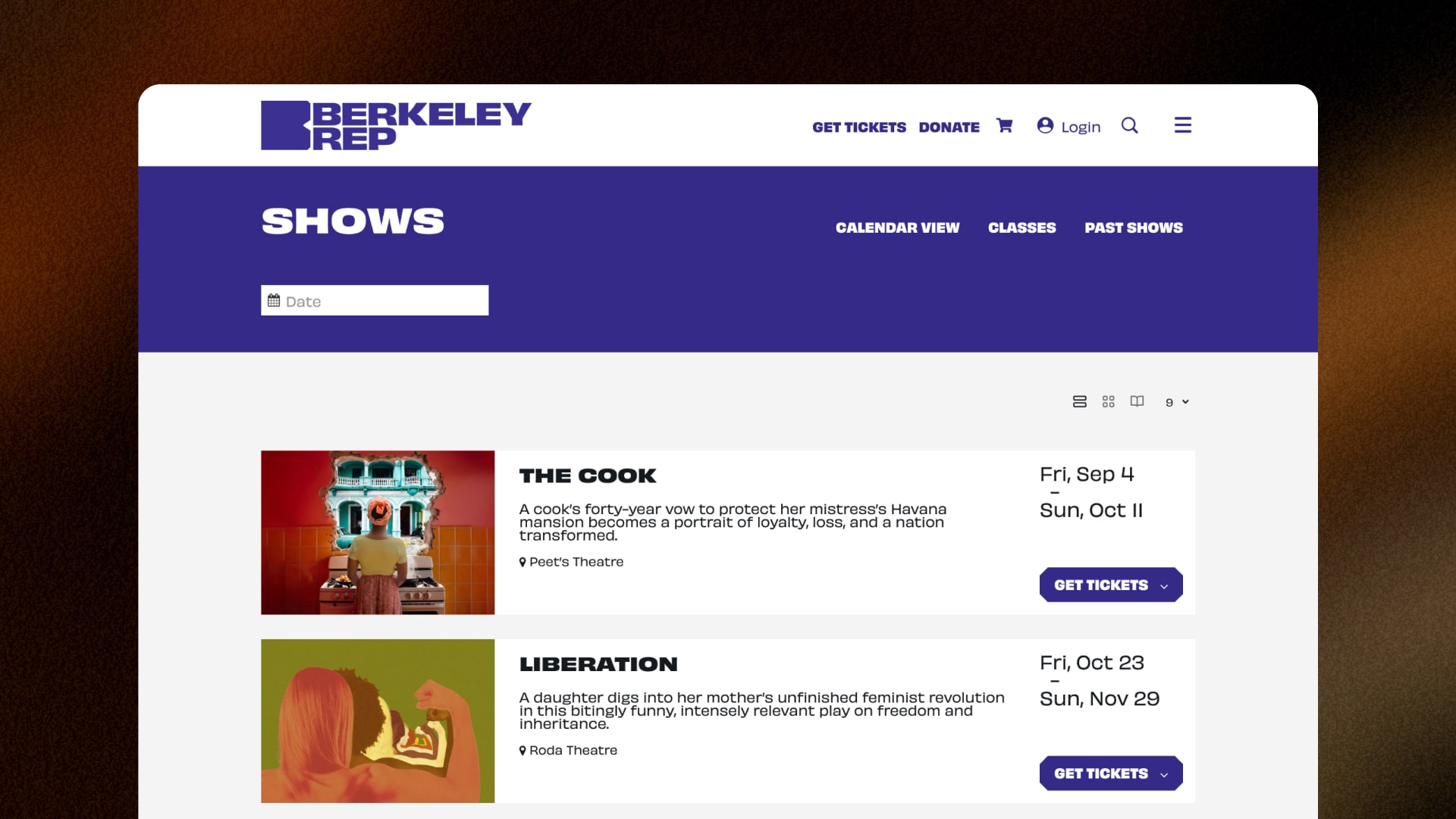
The calendar filter was easy to miss. Browse journeys, purchase journeys, and plan-your-visit journeys all depended on being able to find what was on. They all suffered because the entry point wasn't clear.
Important information was buried
Health and safety requirements – including mask policies for select performances – accessibility details, and class pricing all required work to dig it out. Prospective students had to commit to entering a registration journey just to find out what a class cost.
Manual processes were eating into the team's time
Every show announcement triggered a cycle of manual text edits across event and cart pages to communicate presale windows. Event data had to be entered in Tessitura and then entered again on the website. THis double entry is costly for busy arts marketing teams.
Brand consistency had drifted
The Ground Floor and School of Theatre subsites had started to feel disconnected from the main Berkeley Rep brand – a problem for an organisation for which artistic identity is everything.
What we built
CultureSuite took on Berkeley Rep as a two-phase engagement. Phase 1 focused on getting the organisation onto the CultureSuite CMS quickly and cleanly, while laying the groundwork for a deeper Phase 2 redesign. Here's what Phase 1 delivered.
A seamless Tessitura integration automatically adds key event details
Berkeley Rep was among the first organisations to deploy CultureSuite's new Tessitura Event Updater integration. Before it, the team was manually duplicating event data between Tessitura and the website – a time-consuming process with plenty of room for error.
The integration removed that burden entirely. Tessitura now handles what it should own: dates, times, venues, production IDs. The CultureSuite CMS handles what it should own: marketing content, imagery, copy. The seam between the two systems is clear, and the team no longer has to maintain both sides of it manually.
Tessitura keywords are also pulled through to the event level. So details like closed captions, post-show discussions and accessibility features can surface on the right pages automatically, without anyone having to remember to add them.
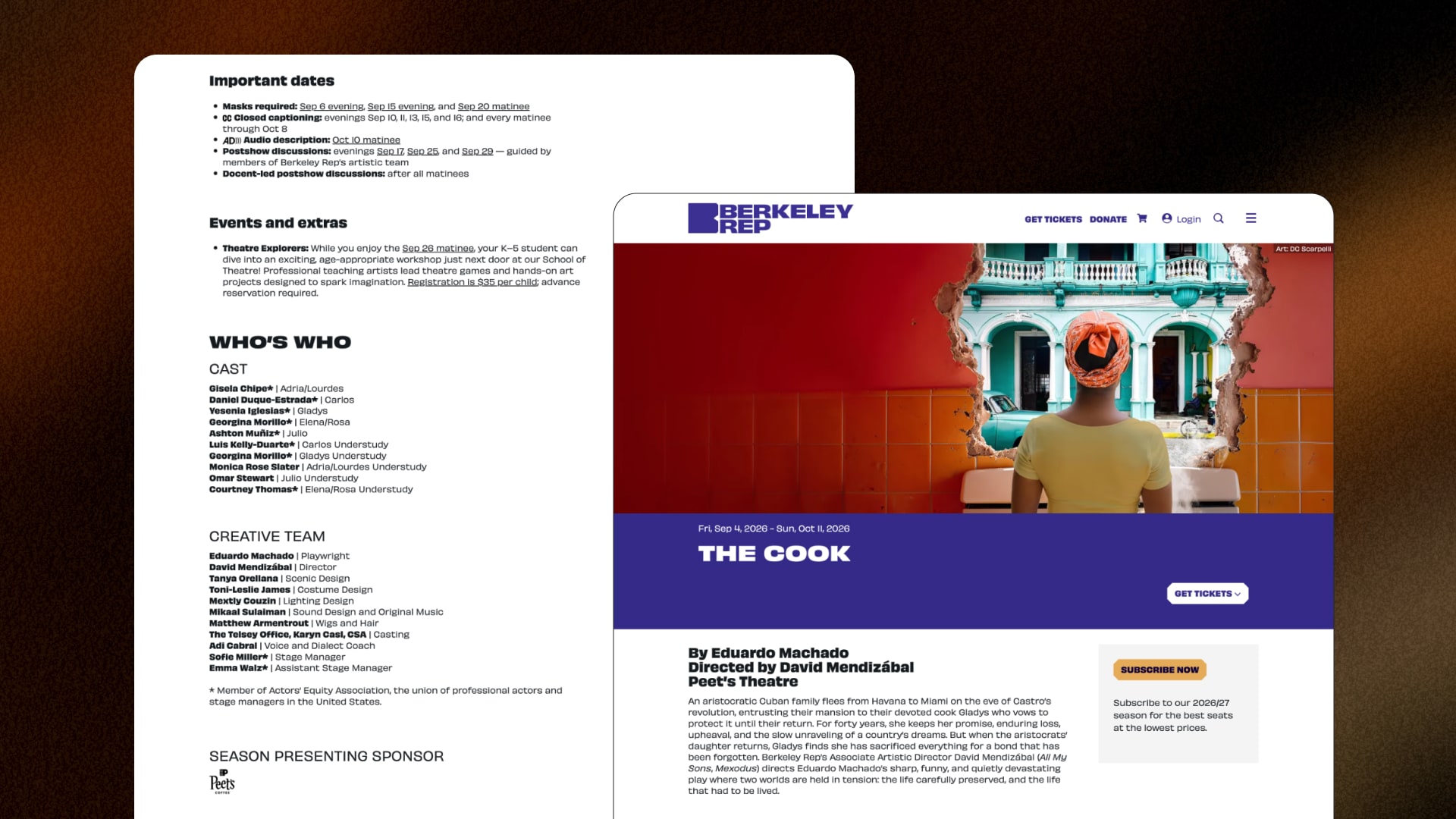
Cross-populated practical information
One of the more powerful features of the CultureSuite CMS is the ability to write a piece of content once and have it appear wherever it's needed. Accessibility details, parking information, plan-your-visit content – these can now surface on event pages, venue pages and visit planning pages without being maintained in three separate places. The time saving across the team is significant.
A consistent brand across every subsite
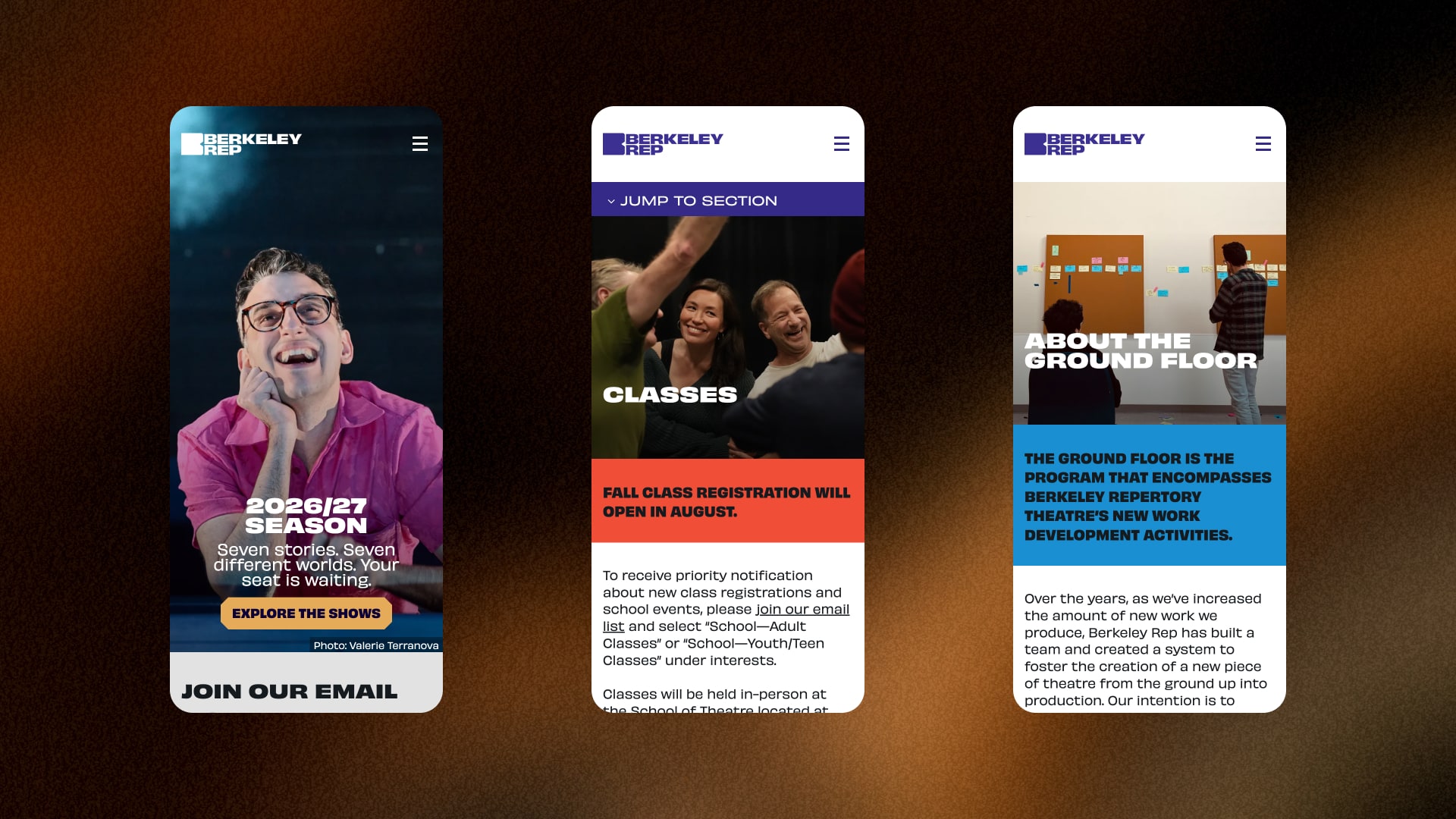
The design work in Phase 1 restored brand coherence across the main site, The Ground Floor and the School of Theatre. All three feel connected to Berkeley Rep's identity – the institutional purple retained throughout, brown as the secondary button colour – without any of the subsites losing their own character.
These weren't decisions handed down by a remote design team. DC Scarpelli, Berkeley’s Creative Director, and the Berkeley Rep team reviewed and shaped the site during CultureSuite's live feedback sessions, giving them the chance to see changes, respond in real time, and stay in control of every creative decision.
A strong technical foundation
Berkeley Rep's Phase 1 Lighthouse scores tell their own story.
Lighthouse is Google's open-source tool for measuring the technical quality of a website. It scores pages across performance, accessibility, and SEO. It's widely used across the industry as an objective benchmark for how well a site is built and how it behaves for real users.
A perfect 100 for SEO means Berkeley Rep's pages are structured exactly as search engines expect – making shows, classes and events easier to find before a patron even lands on the site. An 88 for accessibility means the site is built to serve the widest possible audience, including patrons using screen readers or assistive technology. And an 84 for performance means pages load quickly, reducing the risk of drop-off before a patron has even had the chance to buy a ticket.
What the team said
Destiny Askin, Berkeley Rep's CRM Project Manager and primary expert on the Tessitura integration, was candid and warm in equal measure.
"The go-live was amazing and so fast, with very few issues after the fact. For the most part, the CultureSuite team were very prompt in responding and able to fix issues as they arose.”
The board response after launch was equally telling. One board member – someone outside the project team entirely – described the new site as "lively, dynamic, aesthetically pleasing, and easy to navigate."
An on-site poll of 415 patron responses recorded a 4/5 satisfaction average.
What comes next
Phase 1 was about getting Berkeley Rep onto a platform built for arts and culture, and solving the most critical structural problems. Phase 2 is where the work goes deeper.
The focus is optimisation rather than wholesale rebuild: tightening the ticket-buying path, improving calendar and date-browsing tools, strengthening subscription discoverability, and introducing an automated availability updater that will flip ticket states – available, on-sale soon, members-only, sold out – in real time. That last piece alone will remove one of the most time-consuming manual processes the team currently manages.
Phase 2 is currently in progress.
Sound familiar?
Berkeley Rep's story is one we see often: a venue with genuine artistic ambition, held back by a website that wasn't built for the way arts organisations actually work. If that sounds familiar, chat with our friendly team.
- See how CultureSuite CMS works
Book a personalised demo to see how CultureSuite builds websites for arts and culture organisations. - Keep exploring
Dive into more thinking on digital strategy through our articles, events and webinars, Spotify, YouTube channel or our newsletter.